
| Prep | 45 minutes |
| Cook | about 1 hour 10 minutes: 5 minutes to reduce the juice, then 55 to 65 minutes in the oven at 425°F and 375°F |
| Total | about 6 hours, including 1 hour to chill the dough and 3 hours to cool the pie |
| Serves | 8 slices |
| Equipment | 9-inch glass pie plate, rimmed baking sheet, rolling pin, large pot for blanching, small saucepan, colander set over a bowl, pastry wheel or knife |
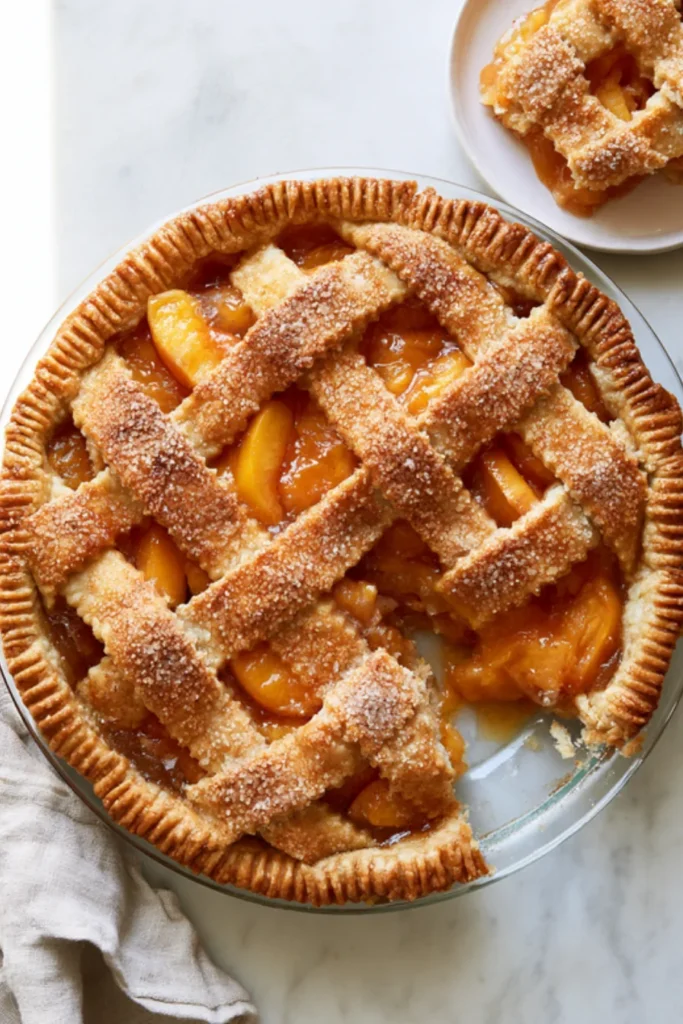
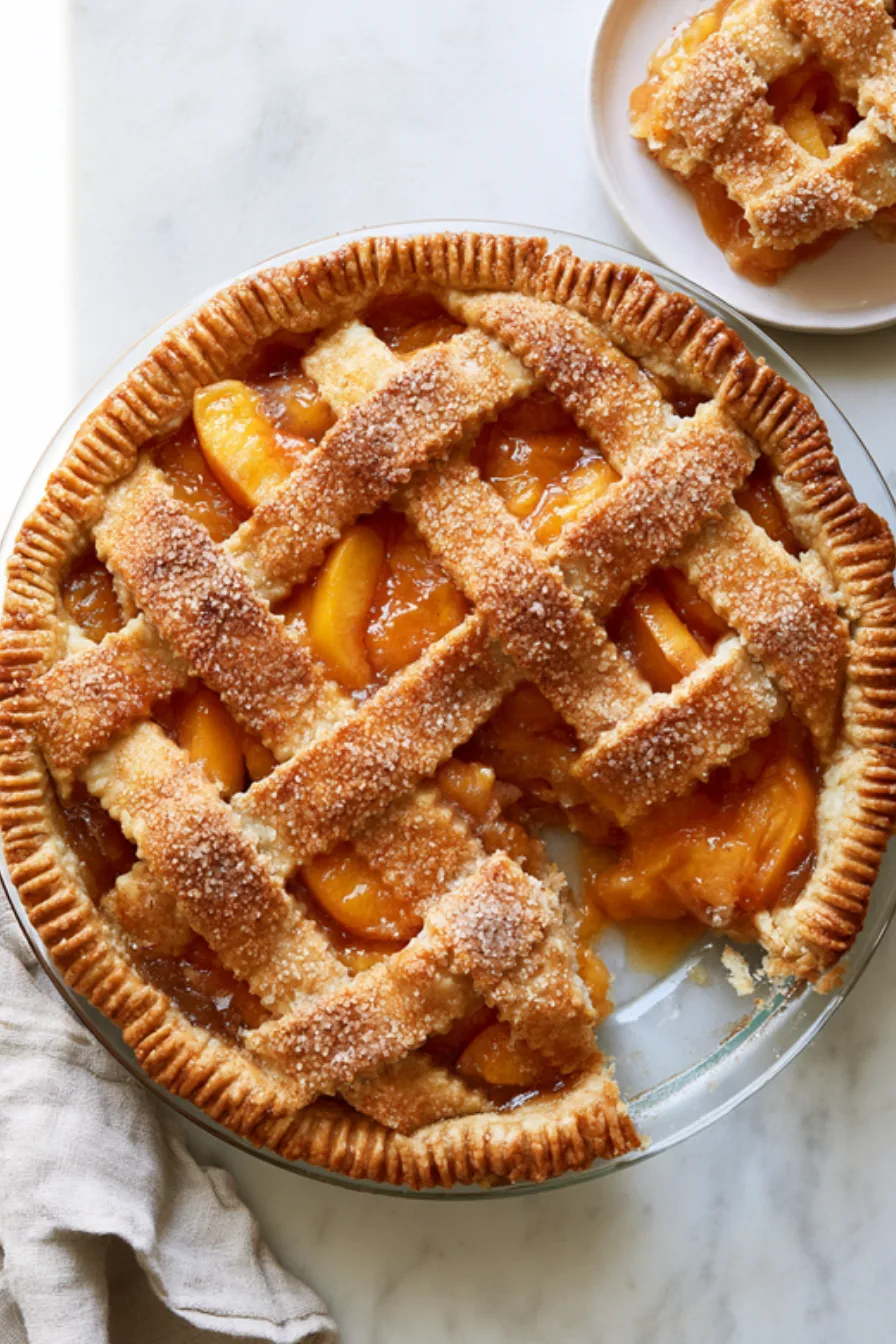
A golden lattice crust with a sparkle of sugar, and underneath it a deep layer of tender peach slices in a glossy, amber filling that holds together when you lift out a wedge. The juice stays in the pie instead of running across the plate, the bottom crust bakes through, and every bite tastes of ripe summer peaches with just a hint of cinnamon.
The trick is handling the juice. Peaches release a lot of liquid as they sit with sugar, and if all of it goes into the pie, you get a soupy filling and a soggy bottom crust. Here, the sliced peaches rest with sugar for half an hour, then the juice is drained off and boiled down on the stove into a thick syrup before it goes back in. The filling keeps all the flavor of the juice with only a fraction of the water, so it sets cleanly as it cools.
Ingredients
For the all-butter double crust
- 2 1/2 cups (300 g) all-purpose flour – enough for a bottom crust and a lattice top.
- 1 tbsp granulated sugar and 1 tsp salt.
- 1 cup (226 g) cold unsalted butter, cut into 1/2-inch cubes – cold butter makes the flaky layers.
- 8 to 10 tbsp ice water – just enough to bring the dough together.
For the peach filling
- 3 lb (about 1.4 kg) ripe peaches – fragrant and slightly soft at the stem end, but not mushy; freestone peaches are easiest to slice.
- 2/3 cup (130 g) granulated sugar – use the lower end, about 1/2 cup, if your peaches are very sweet.
- 1 tbsp fresh lemon juice – keeps the flavor bright.
- 1/8 tsp salt.
- 1/4 cup (30 g) all-purpose flour and 1 tbsp cornstarch – together they thicken the filling without turning it cloudy or gummy.
- 1/4 tsp ground cinnamon and a pinch of nutmeg – a light warmth that lets the peaches lead.
For the top
- 1 large egg, beaten – for a golden, shiny lattice.
- 1 tbsp coarse or granulated sugar – a little crunch on top.
The crust is the same all-butter dough we use for our perfect apple pie, with the top cut into strips instead of left whole.
How to Make It
1. Make the dough – then chill at least 1 hour
Whisk the flour, sugar and salt. Work in the cold butter with a pastry cutter or your fingertips until most pieces are the size of peas, then sprinkle in the ice water a tablespoon at a time, tossing with a fork, until the dough holds together when squeezed. Divide it in half, flatten each half into a disk, wrap and refrigerate for at least 1 hour. You should still see streaks of butter in the dough.
2. Peel the peaches
Bring a large pot of water to a boil and fill a bowl with ice water. Cut a shallow X in the bottom of each peach, lower them into the boiling water for 30 to 60 seconds, then move them straight into the ice water. The skins should slip off easily, starting from the X.
3. Slice and sugar the peaches – 30 minutes
Halve the peaches, remove the pits and cut them into slices about 1/2 inch thick. Toss them in a large bowl with the sugar, lemon juice and salt, and let them stand at room temperature for 30 minutes. A pool of juice will collect in the bottom of the bowl.
4. Reduce the juice – about 5 minutes
Tip the peaches into a colander set over a bowl and let them drain for a few minutes. Pour the juice into a small saucepan and boil it over medium-high heat, stirring now and then, until it has reduced to a thick syrup, about 1/2 cup. Let it cool for a few minutes. The syrup should coat a spoon and bubble slowly, like warm honey.
5. Finish the filling
Return the drained peaches to the bowl. Sprinkle with the flour, cornstarch, cinnamon and nutmeg and toss gently, then pour in the reduced syrup and toss again. Every slice should look evenly coated, with no dry patches of flour.
6. Heat the oven – 425°F (220°C)
Set a rack in the lowest position, put a rimmed baking sheet on it and heat the oven to 425°F (220°C). The hot sheet under the pie plate helps the bottom crust bake through.
7. Line the plate and cut the lattice
Roll one disk into a 12-inch circle and fit it into a 9-inch glass pie plate, letting the extra hang over the rim. Roll the second disk into a 12-inch circle and cut it into ten strips about 1 1/4 inches wide. If the strips feel soft, chill them on a lined tray for 10 to 15 minutes. Cold, firm strips are much easier to weave without stretching.
8. Fill and weave
Spread the filling in the crust. Lay five strips across the pie in one direction, spaced evenly. Fold back every other strip, lay a strip across the other way, then unfold them; repeat, alternating which strips you fold back, until the lattice is complete. Trim the strips and bottom crust to about 1/2 inch past the rim, fold the edge under and crimp it. The lattice should sit flat on the filling, with gaps between the strips for steam to escape.

9. Bake – 25 minutes at 425°F, then 30 to 40 minutes at 375°F
Brush the lattice with beaten egg and sprinkle with sugar. Set the pie on the hot baking sheet and bake for about 25 minutes, until the crust is set and starting to brown. Lower the oven to 375°F (190°C) and bake for 30 to 40 minutes more. Cover the edge with foil if it browns too fast. The pie is done when the crust is deep golden and the filling bubbles thickly in the center, not just at the edges.
10. Cool – 3 hours
Let the pie cool on a wire rack for 3 hours before slicing. The filling thickens as it cools; cut it too soon and it will run, even with the reduced juice.
Why Drain and Reduce the Juice
Peaches are juicy, and sugar draws that juice out quickly. A 3-pound batch of sliced peaches releases a lot of liquid in half an hour. In a closed pie, that liquid has nowhere to go but the bottom crust, and no reasonable amount of thickener can turn it into a filling that slices cleanly.
Draining the peaches first separates the liquid from the fruit. Boiling it down drives off most of the water but keeps all the sugar and peach flavor, so the syrup that goes back in is concentrated, not diluted. The flour and cornstarch then only have to thicken a small amount of liquid, which is why the filling sets glossy and soft rather than stiff or gummy.
The bubbling test at the end matters for the same reason. Both flour and cornstarch need to reach a boil to thicken fully. If the center of the pie is not bubbling when you take it out, the middle of the filling will stay loose even after cooling. Our banana cream pie relies on the same rule for its stovetop custard.
Choosing Your Peaches
Ripe, in-season fresh peaches give the best flavor, but other forms work too.
| Peaches | Works? | How to use them |
|---|---|---|
| Fresh freestone | Best choice | The pit lifts out cleanly, so slicing is quick |
| Fresh clingstone | Yes | Cut slices away from the pit with a paring knife |
| Frozen sliced | Yes | Thaw in a colander over a bowl and reduce the collected juice as in step 4; skip peeling |
| Canned | Not ideal | Softer texture; drain well and use less sugar, since they are already sweetened |
The Oregon State University Extension explains the difference: the flesh of freestone peaches separates readily from the pit, while clingstone flesh clings tightly to it. Both taste good in a pie; freestone just makes the prep faster.
To tell if a peach is ripe, smell it at the stem end and press gently near the stem. A ripe peach smells sweet and gives slightly. Hard peaches will soften on the counter in a day or two.
Weaving a Lattice Without Stress
A lattice looks complicated but is mostly about keeping the dough cold. Warm strips stretch, tear and stick to each other. If the kitchen is warm, weave a few strips, then slide the whole pie into the refrigerator for 10 minutes before finishing.
For a simpler finish, skip the weaving: lay five strips one way and five the other on top, without folding any back. It bakes the same way and still lets steam escape. A full top crust also works, as long as you cut four or five large vents in it.
Make-Ahead and Storing
The dough keeps in the refrigerator for up to 2 days. Peel and slice the peaches on the day you bake, since cut peaches darken as they sit.
Keep the baked pie loosely covered at room temperature for up to 2 days, then move it to the refrigerator. Warm slices in a 350°F (175°C) oven for about 10 minutes to crisp the crust again.
Frequently Asked Questions
Do I have to peel the peaches?
You can leave the skins on, but they can turn chewy and separate from the fruit as the pie bakes. Blanching makes peeling quick.
Why is my peach pie runny?
Usually the juice went in without being reduced, or the pie came out before the center was bubbling. Cooling time matters too; a pie cut warm will always run.
Can I use nectarines?
Yes. Use the same weight; their skins are thinner, so peeling is optional.
For more summer desserts, our fresh strawberry pie needs no oven at all, and our marshmallow pie is an easy make-ahead for a cookout. Find more ideas among our dessert recipes.
Fresh Peach Pie
Ingredients
Method
- Whisk the flour, sugar and salt. Work in the cold butter until pea-sized, then add ice water a tablespoon at a time until the dough holds together. Divide into two disks, wrap and chill at least 1 hour.
- Blanch the peaches in boiling water for 30 to 60 seconds, transfer to ice water and slip off the skins.
- Pit and slice the peaches 1/2 inch thick. Toss with the sugar, lemon juice and salt and let stand 30 minutes.
- Drain the peaches in a colander set over a bowl. Boil the juice in a small saucepan until reduced to a thick syrup, about 1/2 cup. Cool a few minutes.
- Toss the peaches with the flour, cornstarch, cinnamon and nutmeg, then with the reduced syrup.
- Place a rimmed baking sheet on the lowest oven rack and heat the oven to 425°F (220°C).
- Roll one disk to 12 inches and fit it into a 9-inch glass pie plate. Roll the second disk to 12 inches and cut ten 1 1/4-inch strips; chill them if soft.
- Add the filling, weave the strips into a lattice, trim to 1/2 inch past the rim, fold under and crimp.
- Brush with egg and sprinkle with sugar. Bake on the hot sheet about 25 minutes, then lower to 375°F (190°C) and bake 30 to 40 minutes more, until deep golden and bubbling in the center. Shield the edge with foil if needed.
- Cool on a rack for 3 hours before slicing.
Notes


Leave a Reply