
Prep: 40 minutes · Salting: 2 hours · Cook: 5 minutes · Total: 2 hours 45 minutes · Fermenting: 1 to 2 days, then refrigerate · Makes: about 2 quarts (2 liters), 16 servings · Equipment: large bowl, small saucepan, food processor or blender, food-safe gloves, 2-quart jar or two 1-quart jars
If homemade kimchi has let you down before, it was probably for one of three reasons: the cabbage stayed stiff and watery, it came out far too salty, or the paste slid off the leaves and pooled at the bottom of the jar. All three are decided in the first two hours, long before any fermenting happens, and all three are easy to control once you know what to look for.
This is the small-batch, cut-up style of napa cabbage kimchi known in Korean as mak kimchi. Instead of salting and stuffing whole quarters leaf by leaf, you cut the cabbage into bite-size pieces first, which makes it faster to salt, easier to mix and ready to serve straight from the jar. One head of cabbage fills a 2-quart jar, a manageable amount for a first batch.
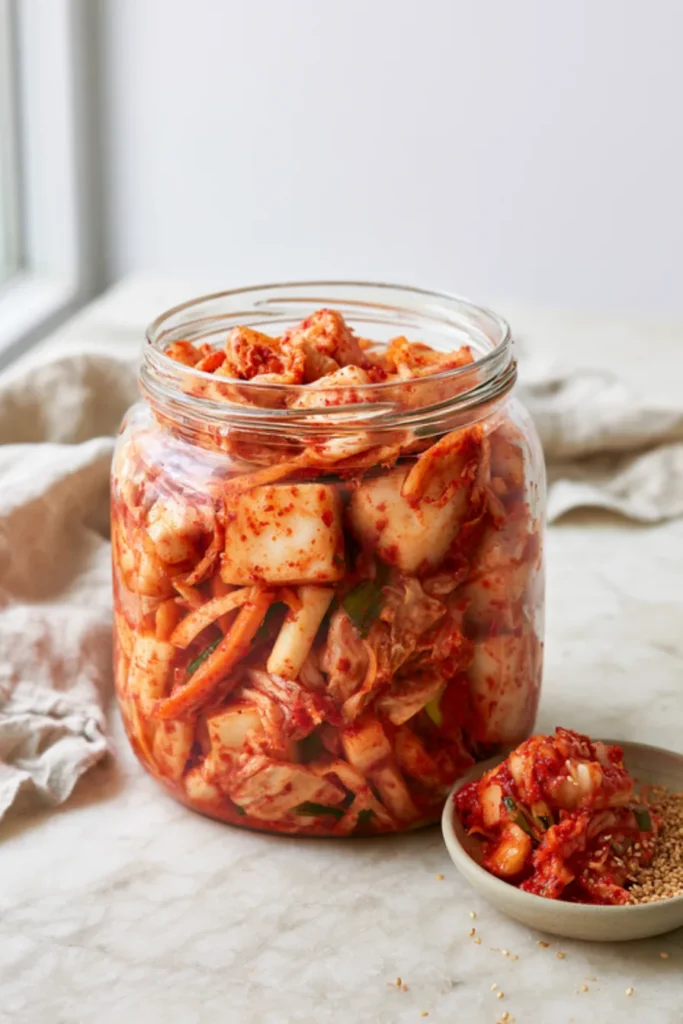
Ingredients
For salting the cabbage
- 1 head napa cabbage, about 3 lb (1.4 kg) – napa has thin, crinkled leaves that soften evenly and soak up the paste; round green cabbage stays much firmer.
- 6 tbsp coarse sea salt dissolved in 1 cup (240 ml) water – coarse salt dissolves slowly and seasons gradually. If you only have fine salt, use less (start with about 4 tablespoons), because a spoonful of fine salt weighs more.
For the rice paste
- 1 cup (240 ml) water
- 2 tbsp sweet rice flour (glutinous rice flour) – cooked into a light porridge, it is the glue that holds the seasoning on the leaves.
- 1 tbsp sugar – a little food for the fermentation and a rounder taste.
For the seasoning
- 1/3 cup (80 ml) fish sauce – the main source of savoury depth.
- 1 tbsp salted fermented shrimp (saeujeot), optional – adds more depth; leave it out if you cannot find it.
- 9 garlic cloves – it sounds like a lot, but it mellows as the kimchi ferments.
- 1 tsp peeled, chopped ginger – a small amount; too much turns bitter.
- 1 small onion, roughly chopped – blended into the paste for sweetness.
- About 1/2 cup chopped Korean (Asian) pear – natural sweetness. Keep to this amount: too much pear makes the mixture too wet to blend smoothly.
- 1 cup gochugaru (Korean red chili flakes) – gives the colour and heat. For a milder kimchi, use 1/2 cup. Do not replace it with ordinary crushed chili flakes, which are much hotter and taste different.
Vegetables
- About 6 oz (170 g) Korean radish or daikon, cut into matchsticks – crunch that holds up for weeks.
- About 1/4 cup carrot, cut into matchsticks – mostly for colour.
- 6 green onions, cut diagonally into 1-inch (2.5 cm) pieces.
- Fresh oysters, shucked and chopped, optional – see the note on oysters below before adding them.
- Toasted sesame seeds, for serving only.
How to Make It
1. Cut the cabbage – 5 minutes
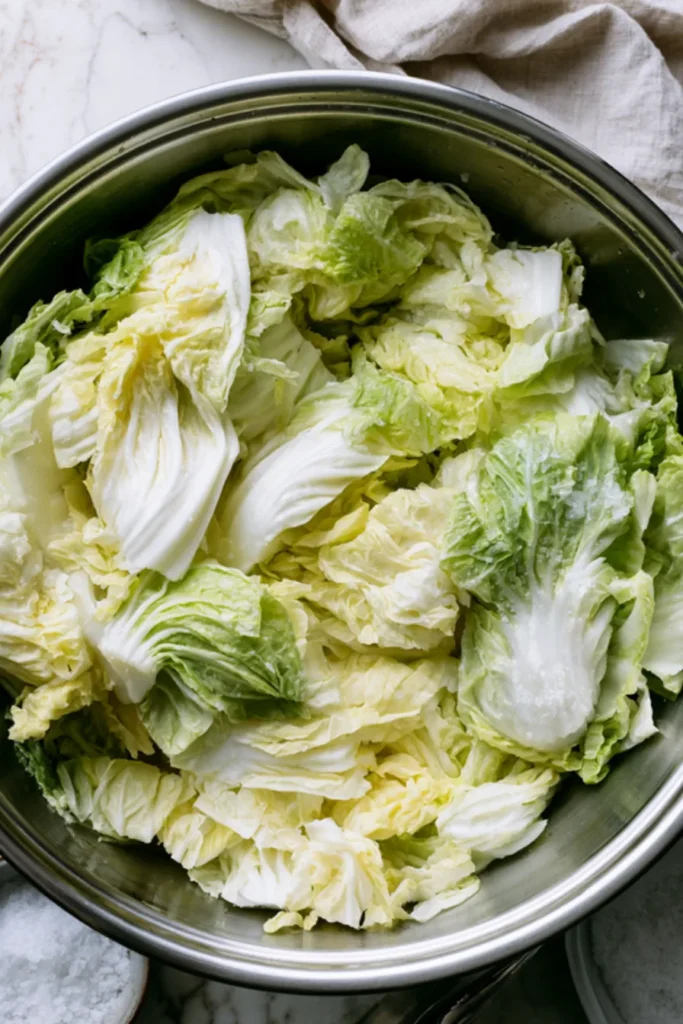
Cut the cabbage in half lengthwise, cut out the hard core at the base of each half, then cut it into bite-size pieces, about 2 inches (5 cm). Rinse the pieces in a large bowl of cold water and lift them out into a colander. You should have a big, loose pile of white ribs and green leaves with no core left.
2. Salt the cabbage – 2 hours, turning every 30 minutes
Stir the salt into the cup of water until mostly dissolved. Put the cabbage in a large bowl, pour the salt water over it and toss well so every piece is coated. Leave it for 2 hours, turning the cabbage from the bottom to the top every 30 minutes so it salts evenly. It is ready when a thick white rib bends without snapping and the cabbage has shrunk to about half its volume.
3. Cook the rice paste – medium-high, about 5 minutes
While the cabbage salts, whisk the sweet rice flour into 1 cup of cold water in a small saucepan. Cook over medium-high heat, stirring constantly, for a few minutes until it bubbles and thickens. Lower the heat, add the sugar and stir for another minute. Turn off the heat and let it cool completely. The paste should look like thin, slightly translucent porridge, with no lumps.
4. Blend the seasoning – 2 minutes
Put the fish sauce, salted shrimp if using, garlic, ginger, onion and pear in a food processor or blender and process until smooth. It should be a thick, pourable purée with no visible garlic pieces.
5. Make the kimchi paste – 5 minutes
In a large bowl, stir the cooled rice paste, the gochugaru and the blended seasoning together. Add the radish, carrot and green onions and mix well. Add the oysters now, if using. The paste should be thick, glossy and deep red, and cling to the radish sticks.
6. Rinse and drain the cabbage – 15 minutes
Rinse the salted cabbage in cold water three times, changing the water each time, then drain it in a colander for at least 10 minutes and gently press out the excess water. Taste a piece: it should be pleasantly salty, like a pickle. If it is too salty, soak it in fresh cold water for 15 to 30 minutes, then drain again. The drained cabbage should feel damp, not dripping.
7. Mix – 5 minutes
Put on food-safe gloves, because the chili stains and burns. Add the cabbage to the paste and fold it through with your hands until every piece is evenly red. No pale white patches should be left on the ribs.
8. Pack and ferment – 1 to 2 days at room temperature
Pack the kimchi into the jar, pressing it down firmly to push out air pockets so the vegetables sit under their own liquid. Leave about 1 inch (2.5 cm) of space at the top, because the kimchi bubbles and rises as it ferments. Close the lid and leave it at cool room temperature, away from direct sun, for 1 to 2 days. Open it once a day to release the gas and press the vegetables back down. Then move it to the refrigerator. Small bubbles rising when you press down and a pleasantly sour smell mean fermentation has started.
Why the Salting Step Decides Everything
Salt draws water out of the cabbage by osmosis. That does two jobs at once: the leaves turn pliable enough to take on the paste, and the water that leaves them no longer dilutes the seasoning in the jar. Under-salted cabbage stays stiff, keeps releasing water for days and leaves a thin, washed-out brine. Over-salted cabbage is limp and harsh, and no amount of fermenting fixes it.
That is why this recipe uses two checks rather than a timer alone: the bend test at the end of salting and the taste test after rinsing. Cabbages differ in size and water content, so two hours is a guide, not a rule. Turning the pieces every 30 minutes matters more than the exact time, because the cabbage at the top of the bowl would otherwise barely salt while the bottom sits in brine.
The rice paste works on the other common problem. On its own, the chili and garlic mixture is grainy and slides off wet leaves. Cooked sweet rice flour gives it body, so it coats each piece and stays there. It also gives the lactic acid bacteria a little extra to feed on.
How Kimchi Changes as It Ferments
Kimchi keeps changing in the refrigerator, only more slowly. Rather than a single “ready” date, it moves through stages, and each one suits a different use. Times are approximate and depend on your kitchen and refrigerator temperatures.
| Stage | What it tastes like | Best used for |
|---|---|---|
| Fresh, same day | Crisp, salty, raw garlic and chili, no sourness | Eating like a salad, alongside grilled meat |
| After 1 to 2 days at room temperature | Lightly fizzy, starting to turn tangy | Side dish with rice and eggs |
| 1 to 3 weeks in the fridge | Balanced sour, salty and spicy; softer cabbage | Everyday side dish, topping for noodles and bowls |
| A month or more in the fridge | Distinctly sour, softer still | Kimchi stew, kimchi fried rice, kimchi pancakes |
| Slimy, mushy or off-smelling | Unpleasant | Discard |
Very sour kimchi is not spoiled kimchi. A strong vinegary taste is simply what happens over time, and it is the stage many cooks prefer for stews. A soft, slimy texture is different: Oregon State University Extension describes it as a sign of spoilage, along with the advice to ferment only a few days at room temperature before refrigerating.
A Note on Oysters
Raw oysters are traditional in fresh kimchi, but they are eaten raw here, and raw shellfish carries a risk of foodborne illness that fermentation does not remove. If you add them, use very fresh oysters from a reliable source, keep that batch in the refrigerator and eat it within a few days. Pregnant women, young children, older adults and anyone with a weakened immune system should leave them out. The kimchi is complete without them.
Storing and Serving
Once refrigerated, kimchi keeps for months, getting more sour as it goes. Always use a clean utensil to take some out, press the rest back down under its liquid, and keep the lid closed so the smell does not spread to the rest of the refrigerator. A glass jar is better than plastic, which stains and holds the smell.
Serve it cold as a side dish, with toasted sesame seeds scattered on top. It is a natural partner for sweet and spicy dishes like gochujang-glazed chicken wings, and chopped well-fermented kimchi is a good addition to Korean BBQ nachos. It also cuts through the richness of steamed cabbage dumplings, and a spoonful stirred into a quick chicken and cabbage skillet at the end adds heat and tang.
For more ideas to serve alongside it, browse the dinner recipes.
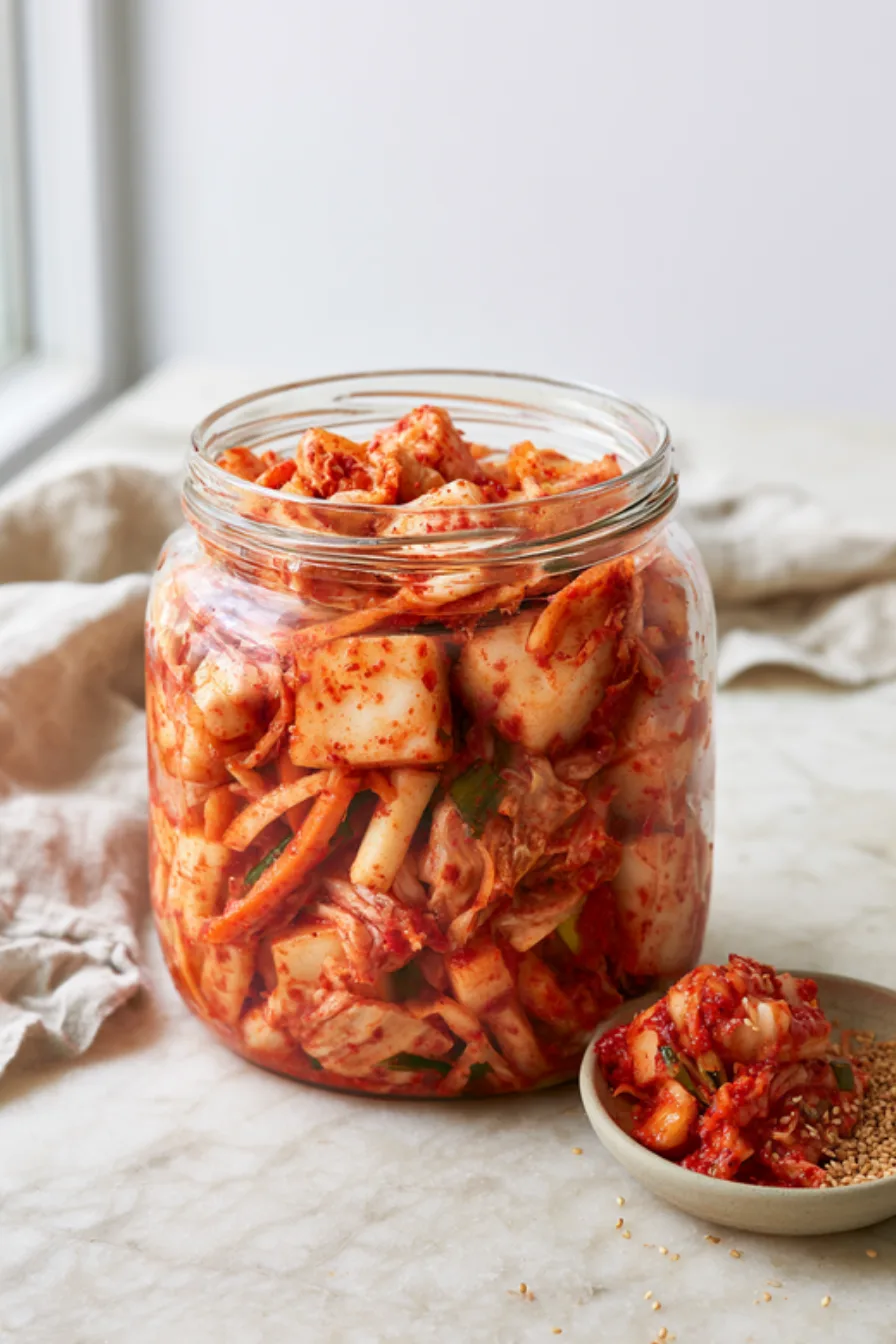
Easy Kimchi (Small Batch)
Ingredients
Method
- Halve the cabbage lengthwise, cut out the core and cut it into bite-size pieces, about 2 inches (5 cm). Rinse in cold water and drain.
- Stir the salt into 1 cup of water. Pour it over the cabbage in a large bowl and toss to coat. Leave for 2 hours, turning the cabbage from bottom to top every 30 minutes, until a thick white rib bends without snapping.
- Meanwhile, whisk the sweet rice flour into 1 cup of cold water in a small saucepan. Cook over medium-high heat, stirring, until it bubbles and thickens. Lower the heat, add the sugar and stir 1 minute more. Turn off the heat and cool completely.
- Blend the fish sauce, salted shrimp (if using), garlic, ginger, onion and pear until smooth.
- In a large bowl, mix the cooled rice paste, gochugaru and blended seasoning. Add the radish, carrot, green onions and oysters (if using) and mix well.
- Rinse the salted cabbage in cold water three times, then drain for at least 10 minutes and gently press out excess water. Taste: it should be pleasantly salty. If too salty, soak 15 to 30 minutes in fresh water and drain again.
- Wearing food-safe gloves, fold the cabbage into the paste until every piece is evenly coated.
- Pack into a jar, pressing down to remove air pockets, leaving about 1 inch (2.5 cm) of headspace. Ferment at cool room temperature for 1 to 2 days, opening once a day to release gas and pressing the kimchi back down, then refrigerate.