
Prep: 20 minutes · Cook: 40 minutes · Cooling: 20 minutes · Total: 1 hour 20 minutes · Serves: 8 · Equipment: 8-inch (20 cm) springform pan, blender or food processor
Most flourless oat cakes come out of the oven as a dense slab that tastes like porridge pressed into a tin. The difference here is ten minutes of soaking. The oats drink up warm water before anything else goes near them, so they soften inside the batter instead of pulling moisture out of it while it bakes. That single step is what turns a bowl of oats into something with a crumb.
What comes out is a cake made of rolled oats, cottage cheese, two apples and honey. No flour, no refined sugar, one blender and one bowl. The flakes stay visible, the walnuts and cranberries give it something to chew on, and a fan of apple slices glazed with warm honey sits on top. It keeps for days, and it slices more cleanly on the second day once it is completely cold.
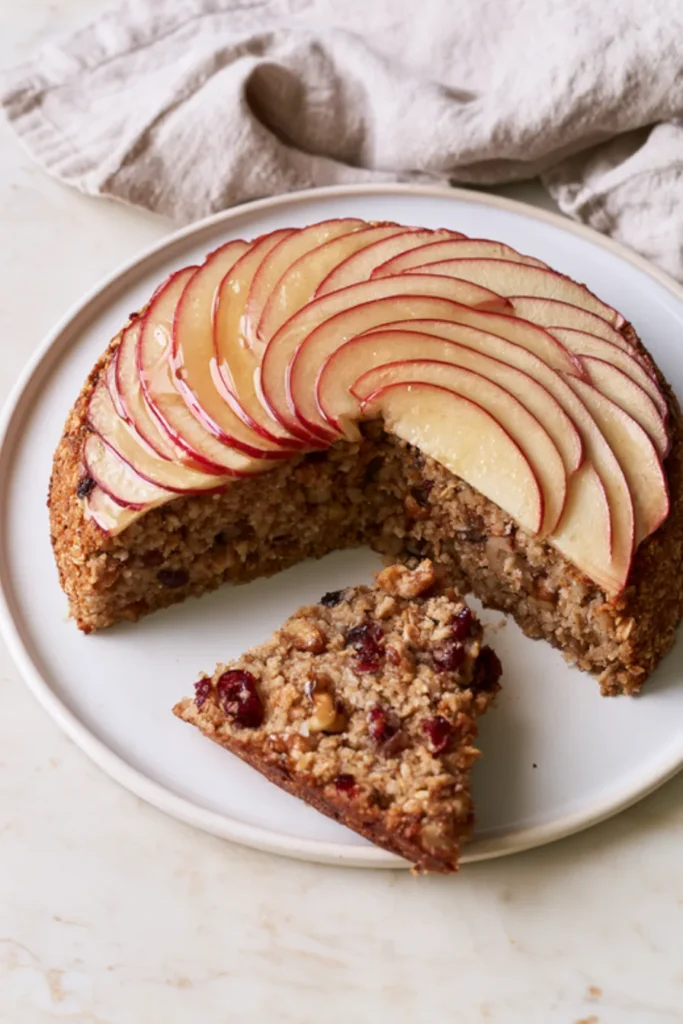
Why This Method Works
Soaking the oats first is the whole difference between cake and baked porridge. Dry oats are thirsty. Dropped straight into a batter, they spend the entire bake pulling water out of the eggs, the apple and the cheese, and they finish the job in the middle of the cake rather than at the edges. Ten minutes in warm water gets the absorption out of the way beforehand, so the batter that goes into the pan is already at its final consistency.
Cottage cheese does the job flour normally does. It is not there for flavour, and you will not taste it in the finished cake. Its casein proteins coagulate in the heat and set into a soft network that holds the oats in place, which is exactly the structural role gluten plays in an ordinary cake. It also carries a lot of water that stays bound up rather than running out into the crumb.
Oats bring no gluten, so the lift has to come from somewhere else. Here it comes from two eggs and a teaspoon of baking powder, helped by the acid in the yogurt. Expect a modest rise of about a centimetre, not a domed sponge. A flourless oat cake that rose dramatically would have to be mostly air, and air is the one thing this cake is not selling.
Honey behaves differently from sugar in a batter this wet. It is hygroscopic, meaning it holds on to water, which is a large part of why the crumb stays moist for three or four days. It also browns faster than sugar does. If the top is colouring before the centre is set, lay a piece of foil loosely over the pan rather than dropping the oven temperature.
Grating one apple and slicing the other is deliberate. The grated apple disappears into the batter and releases its moisture evenly through the crumb. The sliced apple stays defined, keeps its red edge, and gives the cake the only decoration it needs. Doing both with the same apple gets you neither.
Ingredients
For the soaked oats
- 1 cup (90 g) old-fashioned rolled oats — the flakes stay visible in the finished crumb, which is what makes this read as cake rather than porridge
- 100 ml (scant ½ cup) warm water — warm, not boiling; it speeds up absorption without starting to cook the starch
For the batter
- 2 large eggs — along with the cheese, the only thing holding the cake together once the flour is gone
- 100 g cottage cheese — moisture that stays put, plus protein that firms up in the oven
- 2 tablespoons plain yogurt — acid, which wakes up the baking powder and softens the oat bran
- 2 tablespoons honey — the only sweetener in the batter; it also keeps the crumb moist for days
- 1 teaspoon vanilla extract — rounds off the slightly raw edge oats can have
- 1 teaspoon baking powder — with no gluten in the bowl, this is the entire lift
- ½ teaspoon ground cinnamon — enough to read as warm without turning the cake into a spice cake
- ¼ teaspoon salt — leave it out and the cake tastes flat, however much honey is in it
- 1 large apple (about 150 g), peeled and coarsely grated — moisture and sweetness distributed through the crumb
- 60 g walnuts, roughly chopped — fat and crunch, both of which a flourless cake badly needs
- 60 g dried cranberries — sharpness against the honey; check the packet, most are sweetened
For the top
- 1 medium apple, peel on, sliced about 2 mm thick — the peel is what gives the top its colour
- 1 tablespoon honey, warmed — brushed on after baking for shine
- 2 tablespoons sliced almonds — optional, but they toast beautifully against the apple
- Butter, for the pan
Not every oat behaves the same way once it is soaked. This is the one choice that will change your result more than anything else on the list.
| Type of oat | What it does in this cake | Use it? |
|---|---|---|
| Old-fashioned rolled | Absorbs evenly in 10 minutes and keeps a visible flake in the crumb | Best choice |
| Quick-cooking | Drinks the water faster and gives a smoother, denser, more uniform crumb | Yes — soak 5 minutes instead of 10 |
| Jumbo or thick-cut | Needs longer to soften and stays noticeably chewy | Yes — soak 20 minutes |
| Scottish oatmeal | Ground fine, absorbs almost instantly, closer to a baked pudding than a cake | Yes, but the texture changes |
| Oat flour | No flakes left at all; the cake behaves like a soft sponge | Yes, if you want it smooth |
| Steel-cut | Stays hard; 40 minutes in a wet batter is nowhere near enough to soften it | No, unless cooked first |
| Instant oats in sachets | Already sweetened and salted, and collapses into paste | No |
| Certified gluten-free oats | Behaves identically to rolled oats | Yes — necessary for coeliac disease |
That last row matters more than it looks. Oats are naturally gluten free, but ordinary oats are routinely harvested and milled alongside wheat, which is why Harvard’s Nutrition Source page on oats recommends certified gluten-free oats for anyone with coeliac disease.
How to Make It
1. Soak the oats — 10 minutes
Put the rolled oats in a bowl and pour over the warm water. Stir once and leave them alone while you deal with the pan and the apples. They are ready when no loose water pools at the bottom of the bowl when you tilt it.
2. Prepare the pan and the apples
Butter an 8-inch (20 cm) springform pan and line the base with parchment. Peel and coarsely grate the large apple. Slice the second apple, peel on, about 2 mm thick — thin enough to bend without snapping. Heat the oven to 350°F (180°C). The slices should flex when you lift one; if it cracks, it is too thick to soften in the oven.
3. Blend the wet base — 30 seconds
Blend the eggs, cottage cheese, yogurt, honey and vanilla until completely smooth. Do not stop while the cottage cheese is still grainy — those curds will be visible as white specks in the finished slice. The mixture should pour like thin pancake batter and show no lumps against the side of the jug.
4. Fold in the oats, nuts and fruit
Tip the soaked oats into a large bowl, pour over the blended base, then add the baking powder, cinnamon and salt. Fold in the grated apple, walnuts and cranberries. Work quickly once the baking powder is wet. The batter should be thick enough to mound on a spoon and fall off slowly, not pour.
5. Arrange the apple slices
Scrape the batter into the pan and level the top. Lay the apple slices in overlapping circles from the outside in, pressing each one lightly so it sits in the surface rather than on it. Scatter over the almonds. The slices should be half-sunk; any that perch on top will curl and dry out.
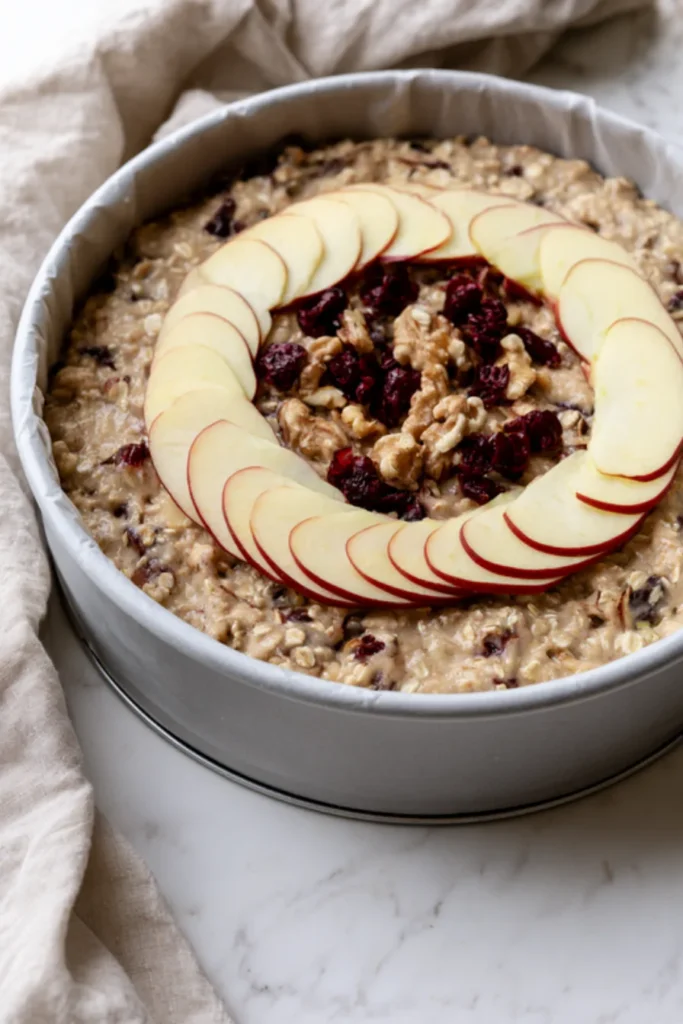
6. Bake at 350°F (180°C) — 40 minutes
Bake on the middle shelf for 40 minutes. If the apples are browning hard before 30 minutes, lay a sheet of foil loosely over the top. It is done when the centre springs back under a finger and a skewer comes out with a few moist crumbs but no wet batter.
7. Glaze and cool — 20 minutes
Warm the remaining tablespoon of honey for a few seconds until it runs, and brush it over the apples while the cake is still hot. Leave the cake in the pan for 20 minutes before releasing the ring. The glaze should look wet and reflective; it sets to a soft shine as the cake cools.
Mistakes to Avoid
- Skipping the soak. The single most common reason these cakes turn out dry. The oats will take their water from somewhere, and if it is not from the bowl it will be from the crumb.
- Under-blending the cottage cheese. Curds that survive the blender do not melt in the oven. They stay as pale lumps in every slice.
- Slicing the topping apple too thick. Anything much over 2 mm will still be raw at 40 minutes while the cake around it is done.
- Treating a clean skewer as the target. This cake is meant to be moist. A completely dry skewer means you have gone five to ten minutes too far.
- Cutting it hot. The egg and cheese network is still setting. Give it the full 20 minutes or the first slice will tear.
- Assuming “no refined sugar” means no sugar. Honey is still sugar, and most dried cranberries are sweetened. This is a better-balanced cake, not a sugar-free one.
Variations
- Pear instead of apple. Use firm pears, slightly under-ripe. Ripe ones collapse into the batter and make it wet.
- Higher protein. Swap the cottage cheese for the same weight of ricotta or quark, and use Greek yogurt in place of plain.
- Dairy free. Replace the cottage cheese with 100 g of thick coconut yogurt and the yogurt with a tablespoon of lemon juice. The crumb is looser but it holds.
- Different fruit and nuts. Dried sour cherries and pecans, or chopped dates and pistachios, both work in the same quantities.
- Spiced. Add ¼ teaspoon each of nutmeg and ground ginger with the cinnamon for something closer to an autumn cake.
Storing and Reheating
Covered at room temperature the cake keeps for 3 days and refrigerated for 5, and it genuinely improves overnight as the oats finish softening. Freeze it whole or in slices, wrapped tightly, for up to 3 months. To reheat, give a slice 15 seconds in the microwave or 5 minutes in a 300°F (150°C) oven — long enough to loosen the honey, not long enough to dry the crumb. If the glaze has dulled in the fridge, a fresh brush of warmed honey brings it straight back.
Frequently Asked Questions
Can I make this without a blender? Yes, but push the cottage cheese through a fine sieve first and whisk it hard with the eggs. A fork alone will leave curds, and curds do not disappear in the oven.
Can I bake it in a loaf tin instead? Yes. A 9 x 5-inch loaf tin holds the same volume but bakes deeper, so add 10 to 15 minutes and check from 50 minutes. The apple topping works less well on a narrow surface — lay the slices in two overlapping rows down the length.
Why is my cake wet in the middle? Almost always the oats. Either they were not soaked, or a quick-cooking oat was swapped in for rolled without shortening the soak, which leaves free water in the batter. Check the table above before changing oats.
Can I use maple syrup instead of honey? Yes, in the same quantity. It is slightly thinner, so the glaze on top will be less glossy. Warm it the same way before brushing.
Can I prepare it the night before? Soak the oats and keep them covered in the fridge, and prepare the blended base separately. Do not combine them with the baking powder until you are ready to bake. If you want something genuinely made the night before, overnight oats are the better format.
Is this a breakfast or a dessert? Both, honestly. It is sweet enough to serve with coffee and substantial enough to eat at eight in the morning. If you want the same idea in a spoonable form, baked oats are the closest relative on the site.
What if I want a classic apple cake with flour? Then this is the wrong recipe and that is fine. The air fryer apple cake gives you a proper tender crumb, and the apple crumb cake gives you the buttery streusel top this one deliberately does without.
For more ways to start the day on something that holds you until lunch, browse the rest of the breakfast recipes, or try the apple cider donut muffins when you want the apple without the oats.
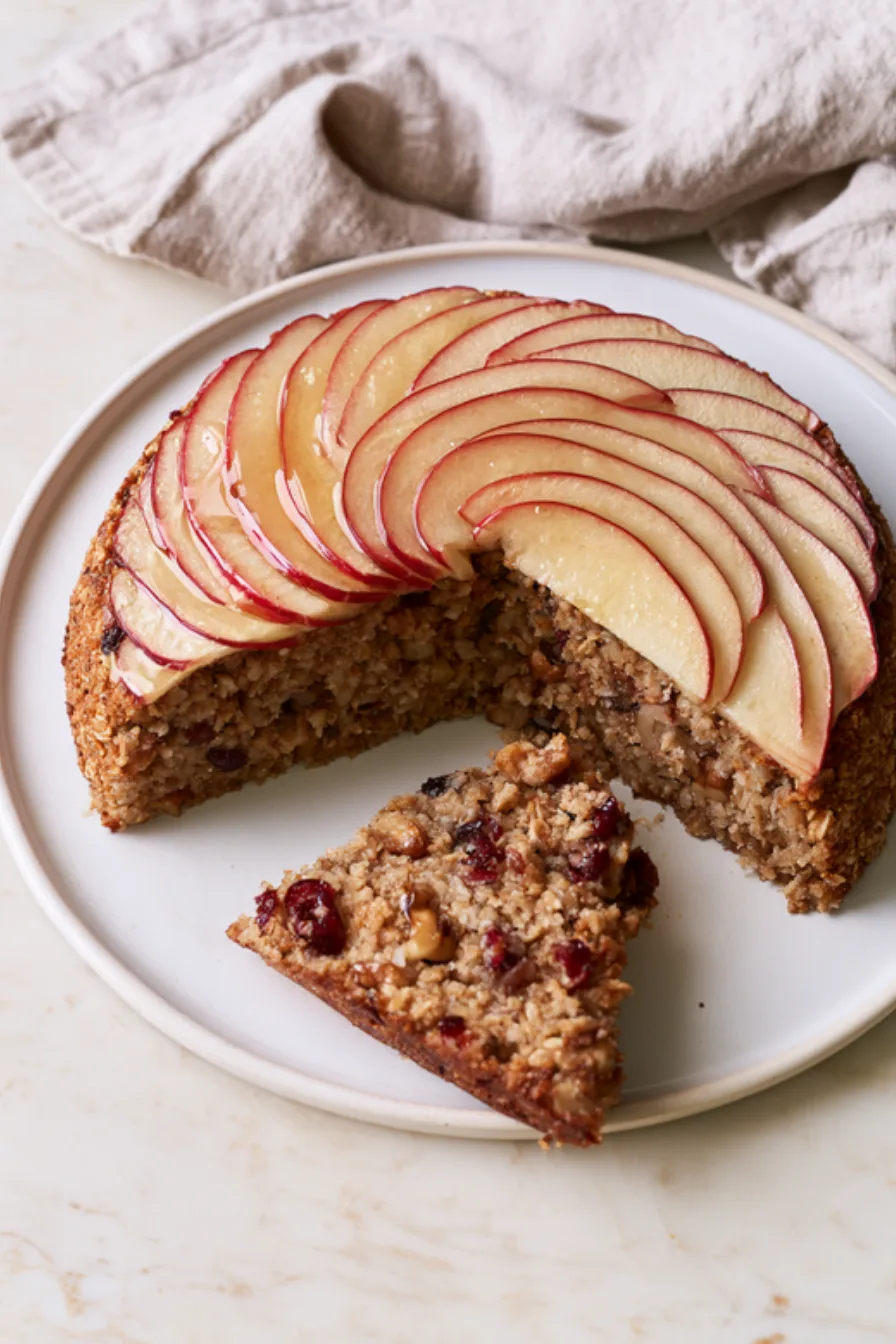
Flourless Oatmeal Apple Cake
Ingredients
Method
- Put the rolled oats in a bowl and pour over the warm water. Stir once and leave them for 10 minutes while you prepare the pan and the apples. They are ready when no loose water pools at the bottom of the bowl when you tilt it.
- Butter an 8-inch (20 cm) springform pan and line the base with parchment. Peel and coarsely grate the large apple. Slice the second apple, peel on, about 2 mm thick. Heat the oven to 350F (180C).
- Blend the eggs, cottage cheese, yogurt, honey and vanilla for about 30 seconds, until completely smooth with no visible curds. The mixture should pour like thin pancake batter.
- Tip the soaked oats into a large bowl, pour over the blended base, then add the baking powder, cinnamon and salt. Fold in the grated apple, walnuts and cranberries. The batter should mound on a spoon and fall off slowly rather than pour.
- Scrape the batter into the pan and level the top. Lay the apple slices in overlapping circles from the outside in, pressing each one lightly so it sits half-sunk in the surface. Scatter over the sliced almonds.
- Bake on the middle shelf for 40 minutes. If the apples are browning hard before 30 minutes, lay a sheet of foil loosely over the top. The cake is done when the centre springs back under a finger and a skewer comes out with a few moist crumbs but no wet batter.
- Warm the remaining tablespoon of honey until it runs and brush it over the apples while the cake is still hot. Leave the cake in the pan for 20 minutes before releasing the ring, then cool completely before slicing.