
Prep: 15 minutes · Draining: 15 minutes · Cook: 30 minutes · Total: 1 hour · Serves: 4 · Equipment: box grater, clean tea towel, 9-inch (23 cm) round tin
Two zucchini and one egg will not become a pizza base on their own. A zucchini is roughly 95% water, and that water has to go somewhere. Left in, it steams the crust from the inside and you lift out a green omelette that tears when you touch it. Taken out first, the same two zucchini turn into a base firm enough to hold a slice flat in your hand.
Everything below is built around that one fact. Salt draws the water out, a tea towel removes it, and a hot oven sets what is left before anything has a chance to go soggy again. No dough, no proving, no rolling pin — and the whole thing is on the table in an hour, most of which is the oven’s work rather than yours.
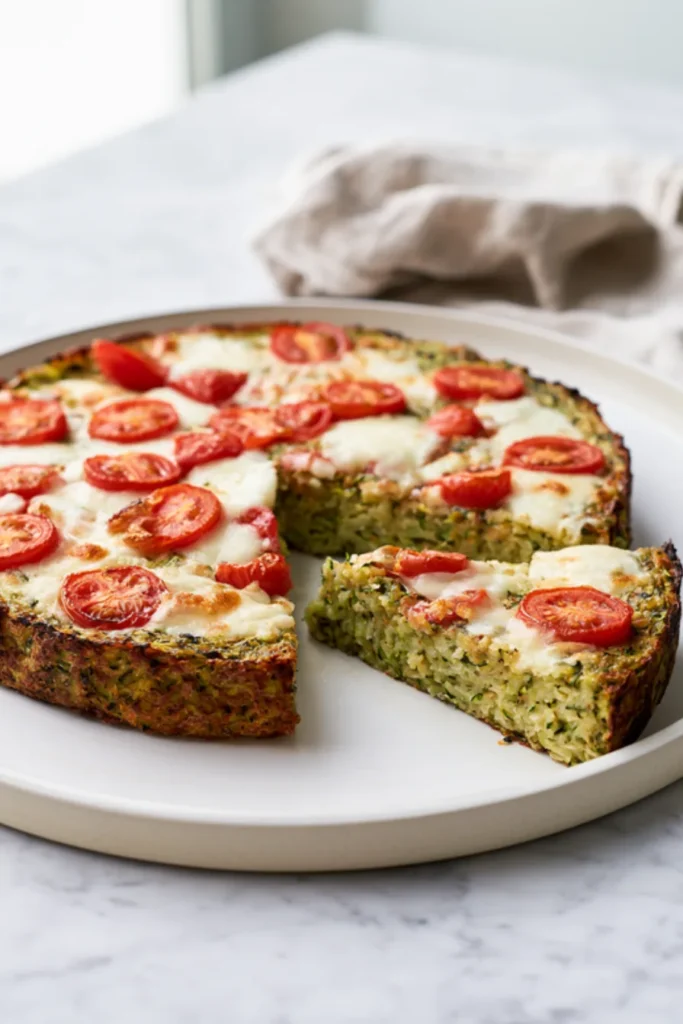
Why This Method Works
Salt does the work that squeezing alone cannot. Wringing out raw grated zucchini gets you some liquid and a sore wrist. Fifteen minutes under a teaspoon of salt first draws water out of the cells by osmosis, so when you finally twist the towel the liquid is already loose and comes away freely. Expect to remove somewhere around half a cup. If almost nothing comes out, the zucchini was not salted long enough.
The crust needs two different cheeses, for two different reasons. Parmesan is dry and hard, so it absorbs residual moisture and adds salt and savour. Low-moisture mozzarella melts into strands that knit the shreds together as the crust cools. Fresh mozzarella in the base is the one substitution to avoid here — it is packed in water, which is the exact thing you have spent fifteen minutes removing.
The crust is baked naked before anything goes on it. This is not optional. Toppings added to a raw base trap steam under the sauce and cheese, and no amount of extra time will dry out what is sealed in. Twenty minutes alone at a high heat drives off the last of the water and sets the egg, and only then does the sauce go on.
The heat drops once the toppings go on. The base needs 450°F (230°C) to dry and brown. The toppings need only to melt and warm through, and at that temperature the crust edge would burn before the mozzarella settled. Dropping to 400°F (200°C) for the last ten minutes gives you a browned base and an evenly melted top instead of one or the other.
Pressing matters more than it sounds. A loosely scattered base bakes into something closer to a frittata. Pressed down firmly and evenly — the back of a spoon, or your palm through a sheet of parchment — the shreds compact into a single layer that slices cleanly.
Ingredients
For the crust
- 2 medium zucchini (about 450 g), coarsely grated — coarse, not fine; fine shreds collapse into paste once salted
- 1 teaspoon fine salt — for drawing out the water, and most of it leaves with the liquid
- 1 large egg — the only thing here that genuinely sets in the heat
- 60 g (½ cup) finely grated parmesan — dry cheese; it mops up whatever moisture the towel missed
- 60 g (½ cup) shredded low-moisture mozzarella — melts into threads that hold the base together as it cools
- 40 g (⅓ cup) all-purpose flour — the binder; see the table below if you want to swap it
- ½ teaspoon dried oregano and ¼ teaspoon black pepper — the crust is otherwise very plain
For the top
- 60 ml (¼ cup) pizza sauce or passata — a thin spread only; a wet layer undoes the whole method
- 100 g (1 cup) shredded low-moisture mozzarella
- 8 to 10 cherry tomatoes, halved — cut side up, so they lose water upward rather than into the cheese
- 1 tablespoon olive oil and fresh basil, to finish
The flour is doing a specific job: mopping up the small amount of water the towel cannot reach, and giving the slice enough flex to bend without snapping. Swap it and the crust changes character.
| Binder | What it does to the crust | Use it when |
|---|---|---|
| All-purpose flour | Absorbs the last of the moisture and gives a slice that bends without snapping | The default — start here |
| Fine breadcrumbs | Crispest edge of any option, closest in bite to a real pizza base | Crunch matters more than anything else |
| Oat flour | Soft and faintly sweet, holds together well, browns gently | Gluten free with a mild flavour |
| Almond flour | Richer and more crumbly, browns noticeably faster — watch the edge | Low carb |
| Coconut flour | Drinks far more water than the others; use a third of the amount or it turns dry and chalky | Low carb, and only sparingly |
| Chickpea flour | Savoury and sturdy, adds protein, slightly beany until fully baked | You want a more substantial slice |
| Cornstarch | Sets glassy and firm, but turns gummy if you use too much | A light, crisp base — 2 tablespoons maximum |
| No binder at all | Relies entirely on egg and cheese; fragile, and best eaten with a fork | Strictly grain free and you accept a softer slice |
Whichever you choose, start with zucchini that is firm and heavy for its size. The University of Maine Cooperative Extension’s guide to zucchini and summer squash recommends storing it unwashed in a perforated bag in the crisper, where it keeps about a week — and a squash that has gone soft in the fridge will give you a limp crust no matter how well you drain it.
How to Make It
1. Grate and salt the zucchini — 15 minutes
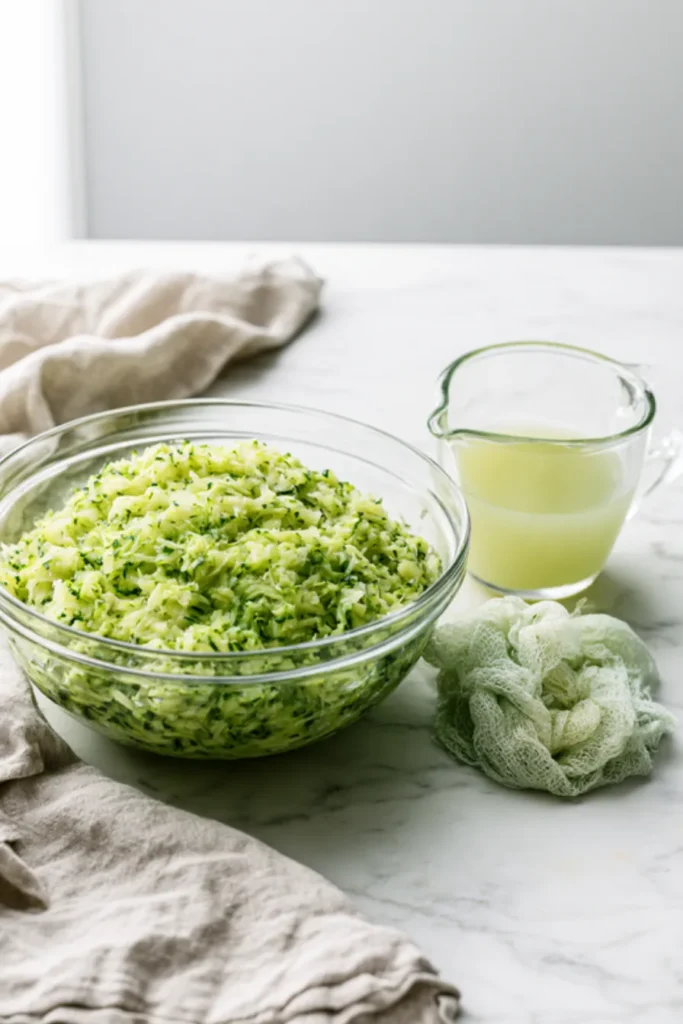
Grate the zucchini on the coarse side of a box grater, skin on. Toss with the salt in a colander set over a bowl and leave it for 15 minutes. Liquid should be visibly collecting in the bowl beneath by the ten-minute mark.
2. Squeeze it properly dry
Tip the zucchini into the centre of a clean tea towel, gather the corners, and twist hard over the sink. Keep twisting until no more runs out, then twist once more. The shreds should feel springy and almost dry, and the pile should have shrunk to roughly half its original volume.
3. Mix the crust
Heat the oven to 450°F (230°C) and line a 9-inch (23 cm) tin with parchment. Combine the drained zucchini, egg, parmesan, the 60 g of mozzarella, flour, oregano and pepper. Taste before adding any more salt — most of the teaspoon left with the water, but not all of it. The mixture should clump when you press it in your hand rather than fall apart.
4. Press it into the tin
Tip the mixture in and press it down firmly and evenly, right to the edges, building the rim very slightly thicker than the middle. The surface should look compacted and smooth, not like a loose heap of shreds.
5. Bake the crust alone at 450°F (230°C) — 20 minutes
Bake on the lower shelf, with nothing on top. It is ready when the edge has browned, the surface looks dry rather than glossy, and the whole round slides when you shake the tin.
6. Top and bake at 400°F (200°C) — 10 minutes
Drop the oven temperature. Spread the sauce thinly, leaving a clear border, scatter over the mozzarella, and arrange the tomatoes cut side up. Done when the cheese has melted and blistered in a couple of places but the tomatoes still hold their shape.
7. Rest before slicing — 5 minutes
Leave it in the tin. The egg and cheese are still firming up, and the difference between cutting now and cutting in five minutes is the difference between a slice and a scoop. Finish with olive oil and basil. A knife should meet resistance from the base, not glide through it.
Mistakes to Avoid
- Skipping the salting step and going straight to squeezing. The single most common reason these crusts come out wet. Unsalted zucchini holds on to its water.
- Grating on the fine side. Fine shreds break down into a purée once salted and bake into a dense, pasty layer rather than a crust.
- Using fresh mozzarella in the base. It is stored in water. Every bit of that water ends up in the crust you just spent a quarter of an hour drying.
- Topping the crust before it has baked. Sauce and cheese seal the surface, and trapped steam cannot escape no matter how long you leave it in.
- Too much sauce. A quarter cup spread thin is the limit. This base has no gluten structure to survive a wet layer.
- Cutting it straight from the oven. Five minutes of rest is what turns it from fragile to sliceable.
Variations
- Yellow summer squash works identically — same weight, same salting time, and the crust bakes a shade more golden.
- Add garlic. One clove, grated into the crust mixture, is the cheapest upgrade available.
- Make it into squares. Press the mixture into a lined quarter-sheet pan for a thinner, crisper result and cut it into bars.
- Swap the topping entirely. Pesto with ricotta, or caramelised onion with feta, both work — the rule is simply that the topping must be thick rather than wet.
- Make the bases ahead. Bake the crusts, cool them completely, and freeze them stacked with parchment between. See below.
Storing and Reheating
Refrigerated in an airtight container, leftover slices keep for 3 days, though the base softens overnight — this is one to reheat rather than eat cold. A hot oven brings it back properly: 400°F (200°C) for 6 to 8 minutes on a rack or directly on the oven shelf, so air reaches the underside. A microwave will heat it through but leaves the base limp. Baked crusts without toppings freeze well for up to 2 months; top them straight from frozen and add about 5 minutes at 400°F (200°C).
Frequently Asked Questions
Do I have to peel the zucchini? No, and you should not. The skin holds the shreds together and gives the crust its green flecking. Trim the ends and that is all.
Can I make it without flour entirely? Yes, but the slice becomes fragile and is better eaten with a fork. If you want it grain free and still sturdy, almond flour at the same quantity is the closest swap — check the table above.
Can I use an air fryer? For a small crust, yes. Press the mixture into a lined air fryer tin and cook at 400°F (200°C) for about 15 minutes, then top and give it 5 more. Watch the edge, which browns faster than in an oven.
My crust fell apart when I lifted it. What went wrong? Almost always one of three things: not enough water removed, the mixture not pressed firmly enough, or cutting before it rested. The binder is rarely the culprit.
Can I prepare it ahead for a weeknight? Bake the crust up to 2 days in advance, cool it completely and refrigerate it uncovered on a rack. Top and finish at 400°F (200°C) for 10 to 12 minutes. Covering a warm crust is what makes it sweat.
Is this actually low carb? With all-purpose flour, it is lower in carbohydrate than a dough base but not low carb. Swap to almond flour and drop the sauce for a thin layer of pesto if that is the goal. If you like this kind of vegetable-for-starch swap, the creamy cabbage alfredo works on exactly the same principle.
What should I serve with it? It is light on its own, so something green alongside helps — garlic butter sautéed spinach takes five minutes, and broccoli stir-fry with garlic sauce turns it into a full plate.
For another way to put parmesan and vegetables at the centre of a weeknight dish, try the parmesan spinach mushroom skillet, or browse the rest of the dinner recipes and lunch recipes.
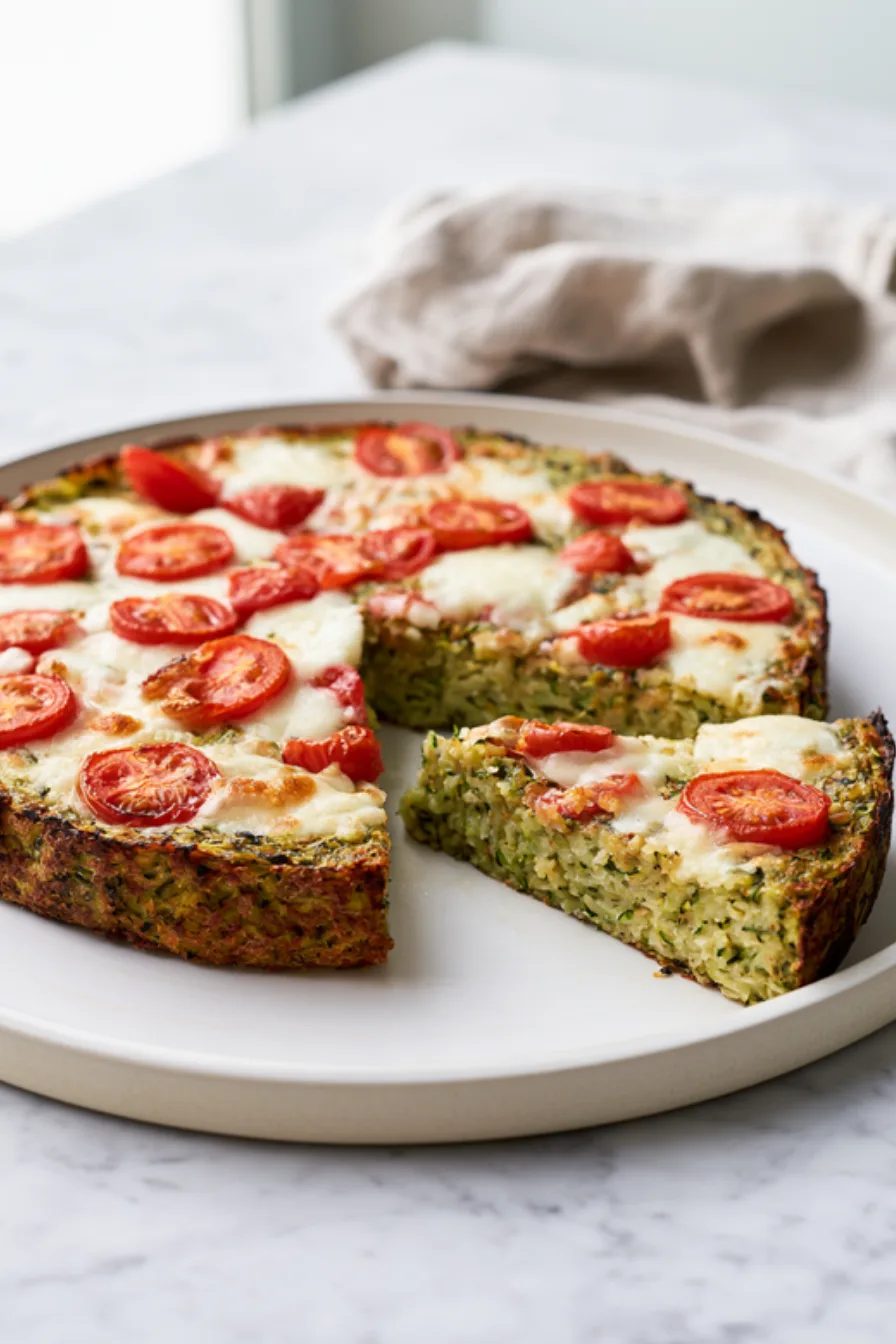
Zucchini Crust Pizza
Ingredients
Method
- Grate the zucchini on the coarse side of a box grater, skin on. Toss with the salt in a colander set over a bowl and leave for 15 minutes. Liquid should be visibly collecting in the bowl by the ten-minute mark.
- Tip the zucchini into the centre of a clean tea towel, gather the corners and twist hard over the sink. Keep twisting until no more runs out, then twist once more. The pile should shrink to roughly half its original volume.
- Heat the oven to 450F (230C) and line a 9-inch (23 cm) tin with parchment. Combine the drained zucchini, egg, parmesan, the 60 g of mozzarella, flour, oregano and pepper. Taste before adding more salt. The mixture should clump when pressed in your hand.
- Tip the mixture into the tin and press it down firmly and evenly, right to the edges, building the rim slightly thicker than the middle.
- Bake the crust alone on the lower shelf at 450F (230C) for 20 minutes, with nothing on top. It is ready when the edge has browned, the surface looks dry rather than glossy, and the round slides when you shake the tin.
- Drop the oven to 400F (200C). Spread the sauce thinly leaving a clear border, scatter over the remaining mozzarella and arrange the tomatoes cut side up. Bake 10 minutes, until the cheese has melted and blistered in places.
- Leave it in the tin for 5 minutes before slicing, then finish with olive oil and basil. Cutting it straight from the oven gives you a scoop rather than a slice.